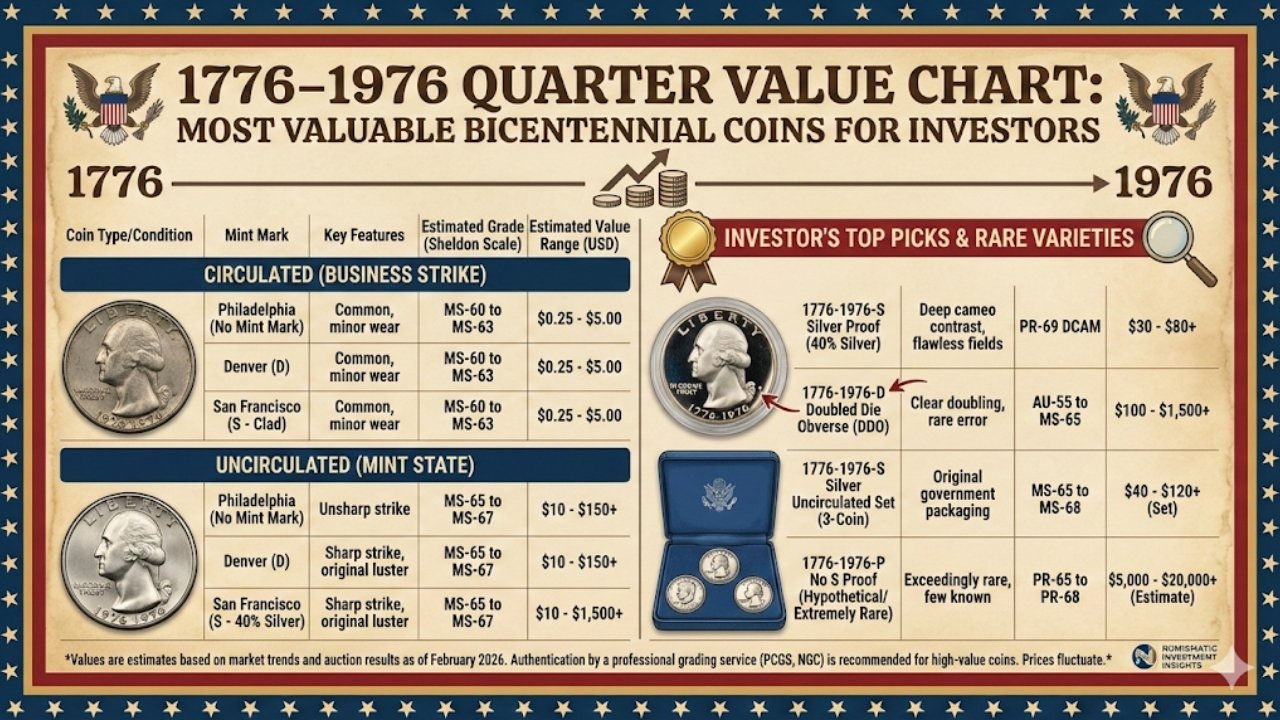

The 1776-1976 Bicentennial Quarter marks America’s 200th birthday with a special design blending history and patriotism. Minted to celebrate the Declaration of Independence signing, these coins feature George Washington on the front and a drummer boy on the back, symbolizing the revolutionary spirit. Collectors and investors prize them for their scarcity in top grades and unique silver versions.
Historical Background
Issued in 1975 and 1976, these quarters replaced the standard design temporarily to honor the nation’s bicentennial. The U.S. Mint produced over 1.6 billion pieces across Philadelphia, Denver, and San Francisco facilities. While most circulated copies hold just face value, uncirculated and silver-clad examples draw serious interest from numismatists seeking portfolio diversity.
Design Highlights
John A. Hulett crafted the reverse image of a uniformed drummer with a torch-bearing rider and moonlit landscape, evoking July 4th festivities. The obverse retains John Flanagan’s classic Washington portrait with dual dates “1776-1976.” These artistic touches make even common versions appealing keepsakes.
Standard Circulation Values
Most clad quarters from Philadelphia and Denver mints trade near 25 cents if worn. Uncirculated rolls fetch $5 to $10. High-grade MS67+ specimens climb to $100 or more, especially with full original luster. San Francisco clad proofs start at $1 in lower grades.
Value Chart Overview
This table summarizes approximate market values for key 1776-1976 Quarter varieties in today’s market. Prices reflect recent auction data for circulated, uncirculated, and proof conditions, varying by exact grade and eye appeal.
| Mint Mark | Type | Circulated | MS65-MS66 | MS67+ / PR69 | Top Auction |
|---|---|---|---|---|---|
| No Mark (P) | Clad Business | $0.25-$1 | $3-$10 | $50-$200 | $3,750 |
| D | Clad Business | $0.25-$1 | $4-$15 | $100-$500 | $4,500 |
| S | Clad Proof | N/A | $2-$5 | $10-$40 | $150 |
| S | 40% Silver Uncirc | $2-$5 | $7-$20 | $25-$60 | $1,200 |
| S | 40% Silver Proof | $5-$15 | $20-$80 | $100-$300 | $19,200 |
Silver Varieties Explained
San Francisco struck 11 million silver uncirculated quarters and 4 million silver proofs, both at 40% silver content. These clad-over-silver pieces appeal to bullion buyers amid rising metal prices. A pristine silver proof in PR70 Deep Cameo can exceed $200, while business strikes in MS68 hover around $50.
Rare Errors and Varieties
Doubled die obverse errors, where lettering doubles faintly, boost values to $100-$500. Off-center strikes or missing clad layers turn common coins into $1,000+ rarities. Investors scour rolls for these anomalies, as low-mintage errors like the 1976-D MS68 command premiums up to $4,500.
Investment Tips
Focus on silver proofs and high-grade clad for steady appreciation. Store in albums away from PVC holders to preserve luster. Track PCGS or NGC population reports for scarcity. With mintages dwarfed by demand, top Bicentennial Quarters offer accessible entry into coin investing.
Market Trends
Bicentennial values rose 15-20% last year due to collector influx and silver at $32 per ounce. Auction houses report brisk sales for MS68+ clad and silver PR70s. Long-term, these coins benefit from historical nostalgia and limited top-grade supply.
FAQs
Are all 1776-1976 Quarters silver?
No, only San Francisco S-mint uncirculated and proofs contain 40% silver; others are copper-nickel clad.
What’s the rarest Bicentennial Quarter?
High-grade silver proofs like PR70 DCAM from San Francisco, with one selling for $19,200.
How to spot valuable ones?
Check mint mark, condition via luster and no wear, and errors under magnification.
Disclaimer
The content is intended for informational purposes only. You can check official sources; our aim is to provide accurate information to all users.
