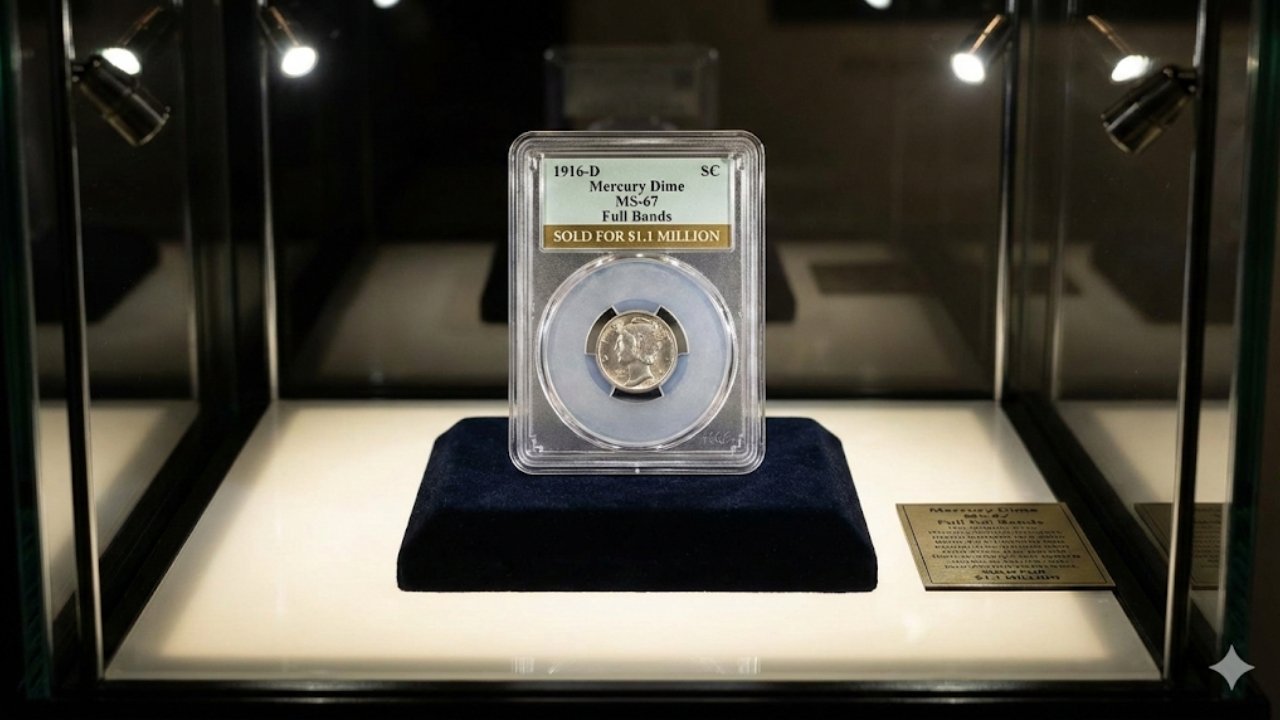

Mercury dimes, those sleek silver coins from the early 20th century, capture the imagination of collectors worldwide with their winged Liberty design often mistaken for the Roman god Mercury. Minted from 1916 to 1945, these dimes became instant icons despite their modest 10-cent face value. Among billions produced, a handful stand out as ultra-rare treasures, fetching eye-watering sums at auction—one even soared past $1.1 million. These top rarities blend low mintage, sharp strikes, and pristine survival against decades of circulation. Let’s explore the elite few that turn pocket change into life-changing windfalls.
The Legendary 1916-D Rarity
The 1916-D Mercury dime reigns supreme as the series’ holy grail, born from Denver’s abbreviated production run of just 264,000 coins. Mint workers shifted focus to quarters midway through, slashing output and dooming most survivors to wear. Full Band (FB) gems, showing crisp details on Liberty’s hair ribbons, command premiums because they’re vanishingly scarce. A PCGS MS67 FB example hammered for $207,000 back in 2010, while whispers of finer pieces push values toward seven figures today. This coin’s story embodies numismatic drama—scarcity meets perfection.
1938-S Full Band Masterpiece
San Francisco’s 1938 output hit 4.8 million, yet high-grade survivors remain elusive due to bag marks and weak strikes typical of the era. The standout sold for $364,250 in 2019—a PCGS MS68+ FB that shattered estimates. Full Bands here highlight razor-sharp wing feathers and hair, traits grading services like PCGS reward handsomely. Even MS65 FBs trade around $10,000, but top-tier coins like this one redefine value ceilings for branch mint dimes. Collectors chase it for its Depression-era mystique and technical brilliance.
Record-Breaking $1.1 Million Sale
Imagine a Mercury dime eclipsing all rivals: that’s the 1942/1 overdate Philadelphia dime, where a doubled-die error layered “1942” atop “1941.” Spotting the faint under-digit requires magnification, making authentication a specialist’s game. One pristine MS68 sold for $1.1 million in recent years, cementing its status as the series’ priciest star. The error arose from hubbing mishaps during wartime production ramps. Fewer than 10 certified at this level exist, fueling bidder frenzy and registry set dreams.
Other Heavy Hitters Worth Hunting
Beyond the headliners, coins like the 1919-D and 1921 Mercury dimes pack punch. The 1919-D’s 1.8 million mintage belies its gem scarcity—MS67 FBs hit $156,000. The 1921, struck only in Philadelphia at 1.2 million amid post-WWI chaos, sees MS66 FBs around $50,000. These underdogs reward patient hunters who scour estate lots for hidden gems. Condition rarity drives their ascent, as circulation devoured most during economic hardship.
| Top Rare Mercury Dimes | Key Feature | Record Auction Price | Mintage |
|---|---|---|---|
| 1916-D FB | Key date | $207,000 | 264,000 |
| 1938-S FB | Condition rarity | $364,250 | 4.8M |
| 1942/1 Overdate | Major error | $1.1M | Unknown |
| 1919-D FB | Low survival | $156,000 | 1.8M |
| 1921 | Wartime | $50,000 | 1.2M |
| 1945 FB (multi-mint) | Final year | $96,000 | Varies |
Why Condition Trumps All
Grading seals a Mercury dime’s fate—PCGS or NGC slabs with Full Bands multiply values exponentially. A plain MS65 might fetch $500, but add FB and it leaps to $20,000 for keys. Toning, luster, and strike quality mesmerize experts, turning coins into art. War-era pieces from 1942-45 often show softer details, yet survivors dazzle. Savvy buyers prioritize “eye appeal” over raw grade, explaining why colorful, blast-white gems dominate headlines.
Hunting Tips for Modern Collectors
Estate sales, bank rolls, and online auctions hide these treasures, but verification is crucial—fakes plague the market. Start with circulated 1916-Ds under $3,000 for entry-level thrills, scaling to certified keys. Join clubs like the ANA for education and networks. Market trends favor strong auctions like Heritage, where fresh rarities spark bidding wars. Patience pays; one grandmother’s jar could yield fortune.
Market Outlook and Legacy
Mercury dimes thrive amid silver bullion rallies and collector influxes, with top values climbing 20% yearly. As fewer unmolested coins surface, demand outpaces supply. These aren’t just money-makers—they’re tangible history from world wars to economic booms. Owning one connects you to a golden age of American coinage.
FAQs
What makes a Mercury dime rare?
Low mintage, Full Bands, and high grades combined with historical quirks.
How do I spot a valuable one?
Check dates like 1916-D, look for sharp bands, and get professional grading.
Can circulated dimes be worth much?
Yes, keys like 1916-D still fetch thousands even in low grades.
Disclaimer
The content is intended for informational purposes only. Check official sources; our aim is to provide accurate information to all users.
